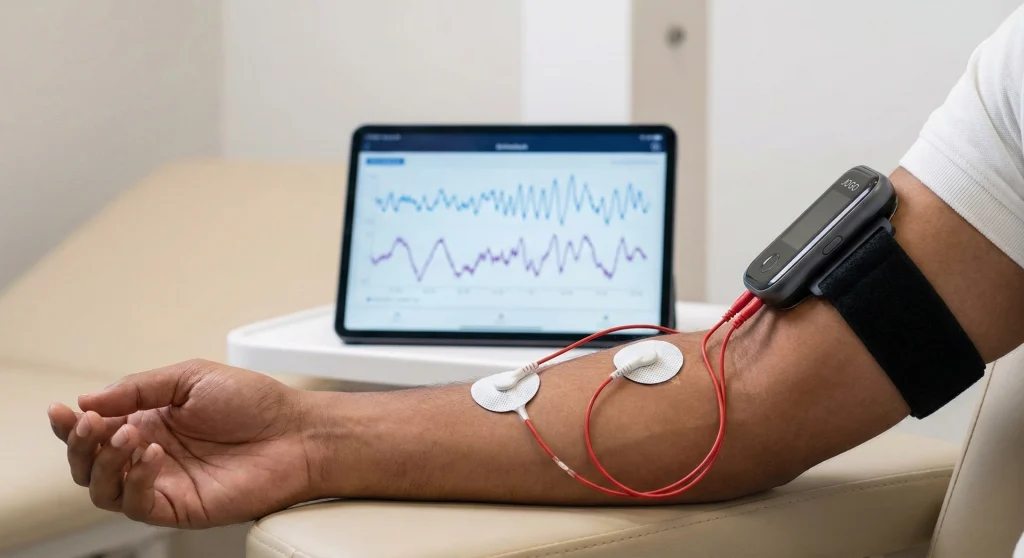
Digital EMG Biofeedback devices are cutting-edge, non-invasive wireless devices that uses Electromyography (EMG) Biofeedback to facilitate neuroplasticity—the brain’s remarkable ability to rewire itself after injury.
How it Works:
- Precision Sensing: Wearable sensors detect even the smallest electrical signals in dormant muscles.
- Real-time Feedback: These signals are converted into instant audio-visual cues, allowing patients to “see” and “hear” their muscle activity.
- Accelerated Recovery: By providing this immediate feedback, the brain builds new neural pathways to bypass damaged ones, restoring motor control and reducing pain.
- Gastroenterological Support: Chronic Constipation and Faecal Leaks (Dyssynergic Defecation).
- Post-Surgical Rehab: Recovery after spinal surgeries, such as L2-L3 Laminectomy.
What Can It Treat?
- Digital EMG Biofeedback is a versatile tool and can be used across multiple clinical disciplines:
- Neurological Recovery: Post-Stroke Disability (paralysis), Chronic Low Back Pain, Movement Disorders (Tremors), Peripheral Nerve Injuries, Facial palsy, Focal Dystonia, and Migraine.
- Urological Health: Urinary Incontinence, Voiding Dysfunction, Pelvic Organ Prolapse, Chronic Pelvic Pain, and Sexual Dysfunction.
- Gastroenterological Support: Chronic Constipation and Faecal Leaks (Dyssynergic Defecation).
- Post-Surgical Rehab: Recovery after spinal surgeries, such as L2-L3 Laminectomy.
Extensive clinical research (2016–2026) confirms the efficacy of EMG biofeedback.
- Parkinson’s Disease & Tremors: Recent systematic reviews demonstrate that EMG biofeedback significantly improves muscle activation, gait, and postural stability in Parkinson’s patients (Diotaiuti, 2025). It is an effective non-invasive tool for tremor suppression and reducing “freezing of gait” (Sharma et al., 2024).
- Urinary Incontinence & Pelvic Floor Health: Meta-analyses confirm that EMG biofeedback is a highly effective treatment for stress urinary incontinence and pelvic organ prolapse, with over 80% of patients showing significant improvement (Wu et al., 2021). It is also the gold standard for treating dysfunctional voiding in children (Passos et al., 2025).
- Chronic Low Back Pain: High-quality meta-analyses show that EMG biofeedback provides a significant reduction in pain intensity and long-term disability for chronic nonspecific low back pain (Sielski et al., 2017). Device specific efficacy has been described in Lazaridou, 2023.
- Post-Surgical Rehabilitation: Clinical evidence supports the use of JOGO EMG biofeedback for successful rehabilitation after complex spinal surgeries, such as L2-L3 Laminectomy, by enhancing motor learning and muscle control (Arjundas et al, 2024).
- Dyssynergic Defecation (Chronic Constipation): Randomized controlled trials have established that EMG biofeedback is an effective treatment for dyssynergic defecation, surpassing laxatives in improving quality of life and bowel function (Simón et al., 2019).
- Stroke Recovery: Studies confirm that EMG biofeedback is an effective therapy for improving motor function in the limbs and treating post-stroke shoulder-hand syndrome (Feng et al., 2023; Wang et al., 2024).
- Focal Dystonia: Specialized biofeedback training has been shown to improve motor learning and normalization of function in both children and adults with focal dystonia and writer’s cramp (Di Biasio et al., 2019; Qi et al., 2018).
References:
Arjundas D ; Rao KBD; Sanklecha S (2024, March 21–23). Use of JOGO EMG biofeedback in post op laminectomy L2-L3 with cauda equina syndrome in improving gait and dynamic balance [Poster presentation]. 18th World Congress on Controversies in Neurology (CONy 2024), London, United Kingdom. https://simul-europe.com/2024/cony/poster
Diotaiuti, P., Marotta, G., Vitiello, S., Di Siena, F., Palombo, M., Langiano, E., Ferrara, M., & Mancone, S. (2025). Biofeedback for Motor and Cognitive Rehabilitation in Parkinson’s Disease: A Comprehensive Review of Non-Invasive Interventions. Brain sciences, 15(7), 720. https://doi.org/10.3390/brainsci15070720
Feng, S., Tang, M., Huang, G., Wang, J., He, S., Liu, D., & Gu, L. (2023). EMG biofeedback combined with rehabilitation training may be the best physical therapy for improving upper limb motor function and relieving pain in patients with the post-stroke shoulder-hand syndrome: A Bayesian network meta-analysis. Frontiers in neurology, 13, 1056156. https://doi.org/10.3389/fneur.2022.1056156
Lazaridou, A., Paschali, M., Vilsmark, E. S., Sadora, J., Burton, D., Bashara, A., & Edwards, R. R. (2023). Biofeedback EMG alternative therapy for chronic low back pain (the BEAT-pain study). Digital health, 9, 20552076231154386. https://doi.org/10.1177/20552076231154386
Passos, C. L., Mendes Souza, M. B., Corrêa Leite, M. T., Carvalho, B. C. N., Saconato, H., & Freitas Filho, L. G. (2025). Efficacy of Electromyographic Biofeedback for Dysfunctional Voiding in Children and Adolescents: A Systematic Review and Meta-analysis of Randomized Trials. Urology, 206, 114–120. https://doi.org/10.1016/j.urology.2025.08.046
Sharma, G., Gupta, A., & Verma, S. (2024). Design of biofeedback foot orthosis to inhibit tremors in Parkinson’s disease. International Journal of Health Sciences and Research, 14(11), 88-95.
Sielski, R., Rief, W., & Glombiewski, J. A. (2017). Efficacy of Biofeedback in Chronic back Pain: a Meta-Analysis. International journal of behavioral medicine, 24(1), 25–41. https://doi.org/10.1007/s12529-016-9572-9
Simón, M. A., Bueno, A. M., Otero, P., Vázquez, F. L., & Blanco, V. (2019). A Randomized Controlled Trial on the Effects of Electromyographic Biofeedback on Quality of Life and Bowel Symptoms in Elderly Women With Dyssynergic Defecation. International journal of environmental research and public health, 16(18), 3247. https://doi.org/10.3390/ijerph16183247
Wu, X., Zheng, X., Yi, X., Lai, P., & Lan, Y. (2021). Electromyographic Biofeedback for Stress Urinary Incontinence or Pelvic Floor Dysfunction in Women: A Systematic Review and Meta-Analysis. Advances in therapy, 38(8), 4163–4177. https://doi.org/10.1007/s12325-021-01831-6
Wang, R., Zhang, S., Zhang, J., Tong, Q., Ye, X., Wang, K., & Li, J. (2024). Electromyographic biofeedback therapy for improving limb function after stroke: A systematic review and meta-analysis. PloS one, 19(1), e0289572. https://doi.org/10.1371/journal.pone.0289572